
ISO 42001 Consulting Services
AI Management System (AIMS) provides a structured way to govern, monitor, and control AI systems responsibly—ensuring transparency, safety, risk mitigation, and accountable AI development across the organisation. ISO 42001 certification strengthens trust with customers and regulators, reduces risks like bias and misuse, and supports safe, scalable AI adoption.
Partnering with Coral eSecure, which has helped 15 AI solutions and 4 AI development companies achieve ISO 42001, gives you proven expertise, faster implementation, and a clear path to responsible, compliant, and trustworthy AI operations.
Questions and clarifications on ISO 42001 scope, approach, implementation or audit? Please get in touch with us for a no-obligation conversation.
Listed below are the key consulting milestones for AIMS ISO 42001 implementation.
Define AI scope, systems, and business boundaries. Identify key use cases and stakeholders involved.Align with regulatory, legal, and ethical requirements. Establish a clear foundation for AI governance.
Create a complete inventory of AI systems and use cases. Assess impact on individuals, operations, and business. Evaluate current governance, risks, and controls. Identify gaps against ISO 42001 requirements.
Design the AI Management System based on scope and context. Define objectives, controls, and governance structures. Customize controls for each AI use case and risk level. Translate requirements into actionable frameworks.
Develop AI governance policies and ethical guidelines. Define procedures for AI lifecycle and operations. Establish controls for risk, bias, and accountability. Ensure alignment with compliance standards.
Implement AI controls and accountability measures. Deploy tools for fairness, transparency, and oversight. Enable continuous monitoring of AI performance. Detect risks such as bias, drift, and deviations.
Define metrics for accuracy, reliability, and compliance. Conduct internal audits of AI governance practices. Evaluate effectiveness of controls and policies. Prepare for management review and certification readiness.
Support documentation and external audit preparation. Assist in Phase I (documentation) and Phase II (implementation). Facilitate engagement with certification bodies. Ensure successful ISO 42001 certification.
| Control Area | Control Requirements |
|---|---|
| Policies Related To AI | 3 |
| Internal Organization | 2 |
| Resources For AI Systems | 5 |
| Assessing Impacts Of AI Systems | 4 |
| AI System Life Cycle | 9 |
| Data For AI Systems | 5 |
| Information For Interested Parties Of AI Systems | 4 |
| Use Of AI Systems | 3 |
| Third-Party And Customer Relationships | 3 |
| Total | 38 |
Experts in QA consulting and software testing, we leverage our in-house automation platform at every stage of the product development life cycle to dramatically boost the quality of your complex enterprise-grade solutions
Listed below are the ISO 42001 Certification Consultant Responsibilities:
1. Scope Definition:
2. Understanding and documenting an AI Model in Terms of Capability, Risks, and Explainability
3. Gap Analysis
4. Impact Assessment
5. Documentation of Policies and Procedures
6. Training
7. Measurement and Monitoring
8. Internal Audit
9. External Audit
10. Ongoing Compliance Support
Artificial Intelligence (AI) is transforming industries worldwide, offering powerful solutions to enhance productivity, efficiency, and decision-making. However, as the adoption of AI grows, so do the complexities and ethical dilemmas surrounding its deployment. This is where a Responsible AI Consultant plays a critical role, guiding businesses to navigate the challenges and opportunities of AI ethically and sustainably.
AI systems often make decisions based on data, but this data can sometimes reflect societal biases. A responsible AI consultant ensures that AI solutions are designed to minimize biases and promote fairness. This includes reviewing datasets, algorithms, and decision-making processes to ensure inclusivity and equity. By fostering ethical AI practices, consultants help businesses avoid reputational damage and ensure their technology benefits everyone equally.
The rise of AI has led to the implementation of stringent laws and regulations, such as European Union's (EU) Artificial Intelligence (AI) Act. Non-compliance can result in hefty fines and legal repercussions. A responsible AI consultant helps organizations understand and adhere to these regulations, ensuring their AI systems operate within the legal framework.
Consumers, employees, and other stakeholders are increasingly demanding transparency in how AI systems make decisions. Without trust, businesses risk losing their competitive edge. A responsible AI consultant ensures that AI models are interpretable and explainable, fostering trust by showing stakeholders how and why decisions are made. This transparency is crucial for building long-term relationships and securing customer loyalty.
AI systems can inadvertently cause harm, such as incorrect predictions or data breaches. A responsible AI consultant identifies potential risks in AI systems and implements measures to mitigate them. This proactive approach minimizes the likelihood of harm and ensures the safe deployment of AI technologies.
AI adoption should align with a company’s mission, values, and objectives. A responsible AI consultant ensures that AI strategies support long-term business goals while upholding ethical standards. This alignment not only drives innovation but also ensures that the AI solutions deliver measurable value to the organization.
The environmental impact of AI, such as high energy consumption during data processing and training, is often overlooked. A responsible AI consultant works to optimize AI systems to reduce their carbon footprint, contributing to the organization’s sustainability goals.
AI consultants can help assist in implementing Standards such as ISO 42001 and NIST AI RMF. These standards help align an organization to define internal processes that ensure responsible AI is embedded in each process associated to AI development lifecycle.
As AI continues to evolve, its potential for both good and harm increases. A Responsible AI Consultant acts as a guide, ensuring that AI systems are not only effective but also ethical, transparent, and aligned with societal values. By addressing ethical concerns, managing risks, and promoting compliance, these consultants play a crucial role in fostering trust, innovation, and sustainability in the AI landscape.
For organizations looking to implement AI responsibly and reap its benefits while minimizing risks, partnering with a Responsible AI Consultant is no longer optional—it’s a necessity.
ISO 42001 provides organizations with a structured approach to managing the risks associated with the design, development, deployment, and use of artificial intelligence systems. Implementing the ISO 42001 offers several key benefits:
ISO 42001 is an international standard for managing artificial intelligence systems responsibly. It helps organizations establish governance, manage risks, and ensure ethical and compliant use of AI technologies.
Any organization that develops, uses, or integrates AI systems can benefit from ISO 42001. This includes technology companies, enterprises adopting AI, and organizations seeking to strengthen governance and compliance.
It improves transparency, reduces risks related to AI, and builds trust with stakeholders. It also ensures alignment with regulatory and ethical expectations, supporting long-term business growth.
The process typically includes scope definition, AI inventory, risk and gap analysis, system design, policy development, implementation, monitoring, and audit support for certification.
The timeline depends on the organization’s size, complexity, and current maturity level. Most implementations can take a few months, depending on readiness and scope.
No. ISO 42001 can be applied whether you are currently using AI or planning to adopt it. It helps establish a structured framework for responsible AI implementation.
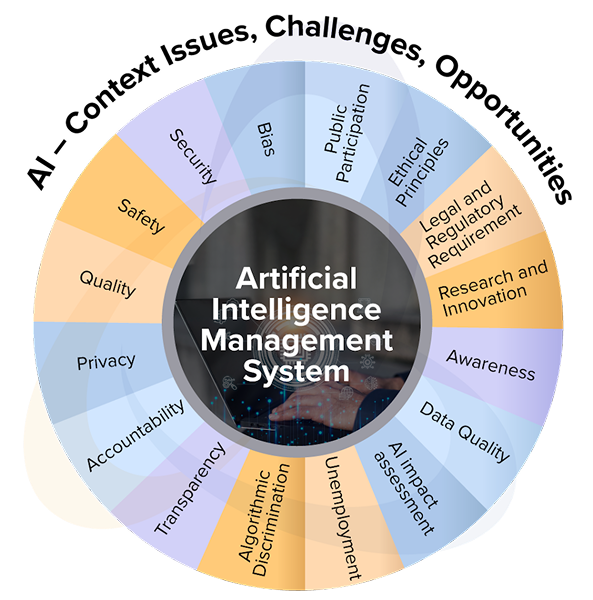
AI risks are evaluated based on factors such as bias, transparency, privacy, accountability, and system impact. This helps organizations prioritize controls and mitigation strategies.
Yes. ISO 42001 is designed to align with existing management systems like ISO 27001, ISO 27701, and other governance frameworks, making integration seamless.
The audit is conducted in two stages:
Stage 1 reviews documentation and readiness
Stage 2 evaluates implementation and effectiveness of controls
We use cookies to enhance your browsing experience, analyze site traffic, and support our digital services. By clicking “Accept”, you consent to our use of cookies.